I've been covering the link between future trends and innovation strategies for 30+ years. I went back through my blog posts, stretching to 2002, to dig out the nuggets of innovation insight I've discovered along the way. This series revisits those stories, tests what still holds up, and turns them into practical lessons for what comes next.
I've come back to this idea repeatedly in my work because the mindset behind innovation usually changes before the results do. What people notice, question, challenge, and act on determines how ready they are for what comes next.
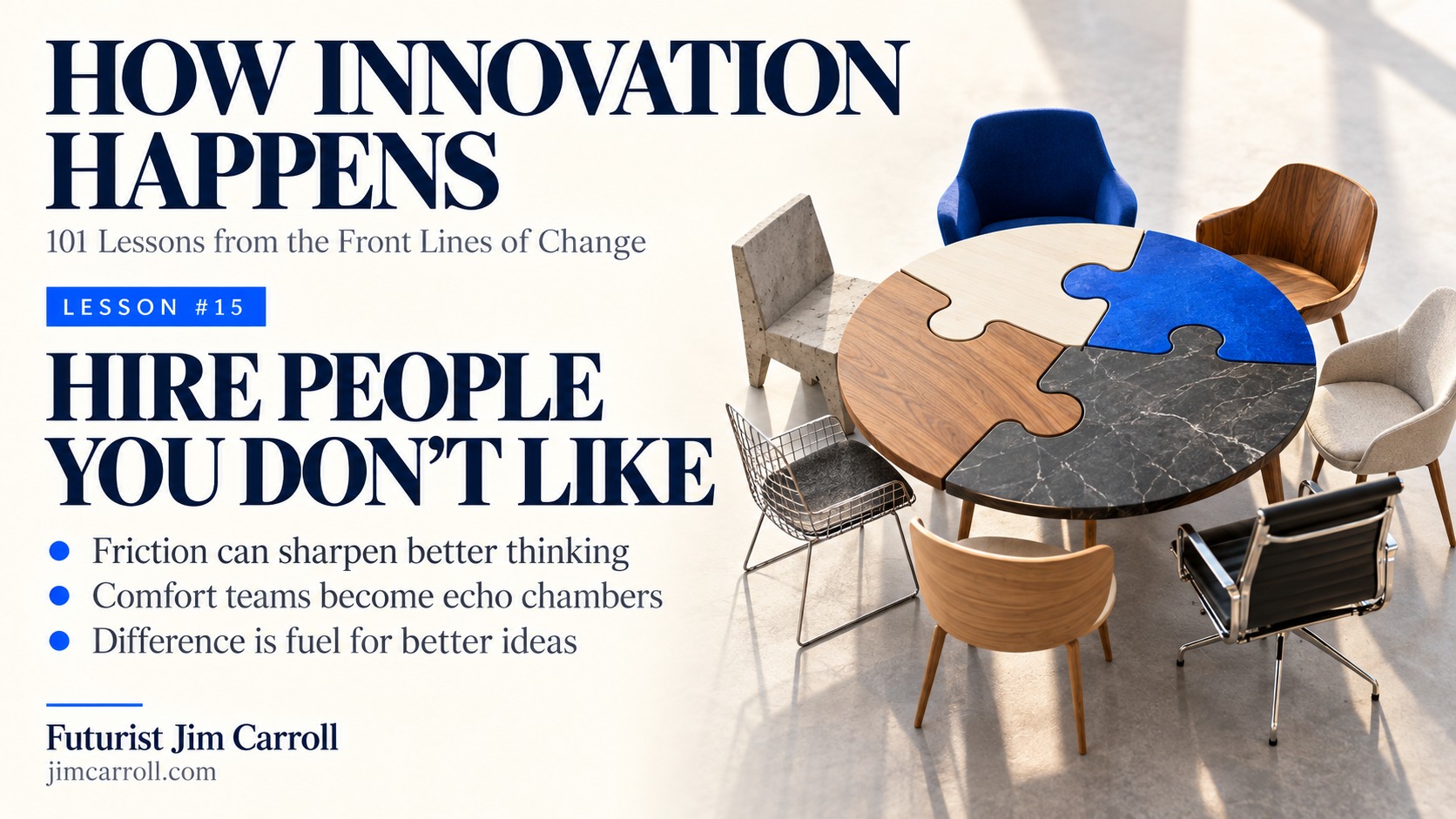
Innovation suffers when everyone in the room thinks alike, talks alike and validates the same instincts.
Years ago I used a deliberately provocative phrase: hire people you don't like. The point is not to hire unpleasant people. It is to resist building a team made entirely of people who make you comfortable.
A useful innovation team contains friction. Different backgrounds, different assumptions, different professional languages and different ways of seeing risk. If everyone immediately agrees, you may have harmony, but you probably do not have much cognitive diversity.
Comfort is wonderful for friendships. It can be dangerous for strategy.
So what does that mean in practice? It means challenging the assumption, habit, or hesitation that is keeping you anchored to the present. Here are three places to start.
Action Items:
- Look at your leadership team and identify where the thinking is too homogeneous.
- Invite one respected dissenter into your next strategy session.
- Ask candidates what they disagree with your industry about, not just why they want to join it.
Explore the full How Innovation Happens series.
Real-World Examples
These researched examples show the lesson at work in the real world.
TRM Labs: A CTO asks his team why his own idea is wrong
Hiring clever people is not the same as benefiting from what they think. At blockchain-intelligence company TRM Labs, an internal practice known as farming for dissent tries to make disagreement normal rather than career-threatening. In a June 2026 company account, employee Devin Blase described watching the chief technology officer, Rahul Raina, move around a meeting asking colleagues to identify flaws in his own proposal.
The meeting was not a performance in which staff were expected to flatter the boss before returning to business as usual. The stated aim was to challenge assumptions early and allow the better proposal to emerge regardless of where it began.
TRM explicitly distinguishes this from endless debate or rewarding people simply for being contrarian. It requires people who can challenge one another without converting disagreement into a personal contest. The account is a company description of its own culture, not an independent audit of whether every employee always feels safe to dissent.
Still, the practice offers a concrete test of a leader's sincerity: does the most senior person in the room actively ask for a credible case against the idea they just proposed? If not, intellectual diversity may be present on the payroll but absent from the decision.
Why it matters: The most useful colleague is sometimes the one whose reasoning makes your favourite assumption impossible to defend.
Sources:
The military red team: The junior officer whose answer beat the generals
The US military has developed structured red-teaming methods because experienced leaders can become trapped inside the assumptions shared by their own group. An account published by the US Army's NCO Journal describes a telling exercise after a 2014 cheating scandal involving Air Force nuclear missile officers.
Senior military leaders were brought together to examine the problem with a red-team instructor. Using an anonymized idea-rating technique, the group gave a top score to a suggestion: ask junior missile officers why they had felt such pressure to cheat. When a senior leader asked who had submitted the idea, a junior aide eventually identified himself.
The instructor's point was that a familiar hierarchy might have prevented the group from hearing the idea if its author had been identified at the beginning. The story is presented in an Army educational publication as an illustration of groupthink mitigation, not as proof that the subsequent investigation was solved by this single suggestion.
Its importance is the mechanism: temporarily remove status signals so inconvenient perspectives have a fair chance to influence decisions. In most businesses, a person who challenges the senior team's interpretation risks being seen as difficult. In this exercise, that challenge was the contribution.
Why it matters: It is not enough to hire people with different opinions. A decision process must keep rank, familiarity and politics from filtering out their best observations.
Sources: