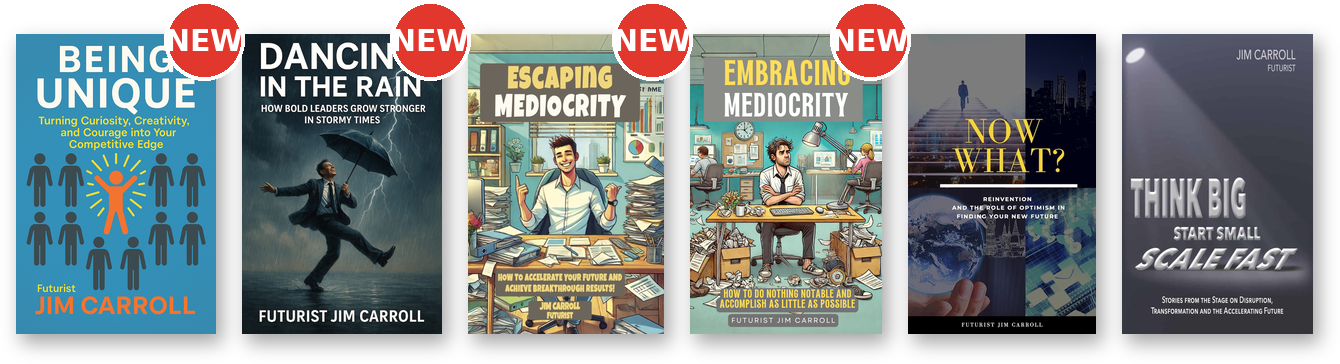

“Celebrate your flaws and highlight your mistakes – because one day soon, they will become your key currency for success!” – Futurist Jim Carroll

One year ago, in August 2025, I published Megatrend #28: The Chase for Authenticity as part of my 30 Megatrends series. Time to grade myself.
Here’s how I set it up back then:
As the market becomes saturated with AI-generated content, a significant shift is occurring where consumers and businesses increasingly value and pay a premium for verifiably human, live, and authentic experiences.
We’re entering a market where synthetic content is cheap, constant, and often indistinguishable from the real thing. In that fatigue, a counterforce is emerging: people will seek signals that what they’re seeing, buying, or trusting is genuine.
The brand-trust data landed exactly where I called it: brands rated “highly culturally authentic” in 2026 research see a 27% higher trust score and a 19% lift in purchase intent, unedited footage and imperfect captions are now measured as trust signals rather than liabilities, and 94% of consumers say they’ll stay loyal to brands offering full transparency. Influencer trust climbed to 67% in 2026, with 18–34-year-olds now ranking creator content as their single most trusted source of information — ahead of traditional advertising and, in plenty of cases, ahead of the brands themselves.
But the “human curator” piece of the original post — actual people doing the vetting, not algorithms — turned out to be the bigger story. Independent bookstores didn’t just survive the AI content flood; the US count is up 70% since 2020, 422 new shops opened in 2025 alone (up 31% over 2024), and 73% of American Booksellers Association members reported sales growth that year — a curated, human-selected retail category outperforming a flat overall book market.
Paid newsletters did the same thing on the media side. Substack crossed 8.4 million paid subscriptions in Q1 2026 — up 68% from the 5 million mark barely a year earlier — with more than 40,000 creators now earning money directly from readers who chose to pay a specific human for a specific point of view, and subscription revenue across creators running past $500 million a year.
Corporate communications moved the same direction. Unscripted CEO video — phone-shot updates, live Q&A, no teleprompter — is now generating roughly 200% higher engagement than polished corporate messaging, and the “town hall” reinvented itself as a broadcast event competing with the same platforms employees watch after work. The press release didn’t disappear. It just stopped being the primary way a leader gets heard.
Hiring turned out to be the sharpest edge of this trend. 87% of companies now run AI resume screening, and roughly three in four resumes never reach a human being — exactly the “flawless resume becomes generic” problem I described. The counter-move is real too: 43% of employers now prioritize skills over credentials, 45% have dropped degree requirements outright, and live problem-solving, work samples, and job simulations are replacing the interview as the place candidates actually prove themselves.
Verdict: Nailed it, and undersold it. The brand-trust research was the easy part of this prediction. The harder, more interesting part — readers routing around the algorithm, and candidates being judged on work instead of a résumé — is the one actually reshaping bookstores, newsletters, boardrooms, and hiring desks all at once.


GET IN TOUCH
Jim's Facebook page
You'll find Jim's latest videos on Youtube
Mastodon. What's on Jim's mind? Check his feed!
LinkedIn - reach out to Jim for a professional connection!
Flickr! Get inspired! A massive archive of all of Jim's daily inspirational quotes!
Instagram - the home for Jim's motivational mind!