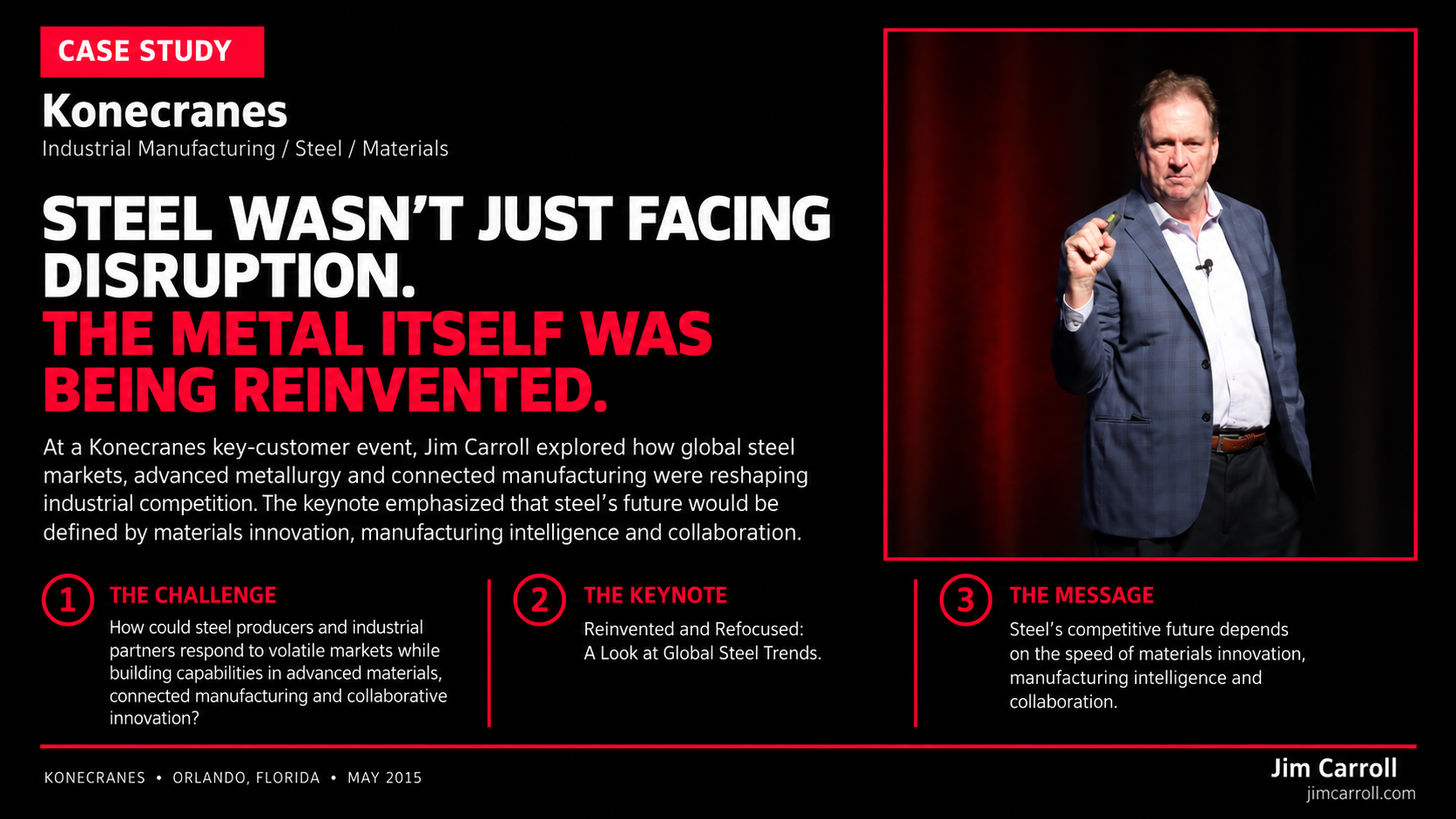
In May 2015, Jim Carroll delivered a Konecranes keynote centered on the forces transforming the global steel industry. The keynote addressed market pressure, advanced metallurgy, new energy technologies, digital manufacturing and collaborative innovation.
Carroll began with the economic pressure facing global steel. Slower growth in China, excess production capacity, changing demand and falling prices created uncertainty for traditional producers and their suppliers. These were more than temporary market fluctuations: the industry's future could also be influenced by new materials, competing production methods and shifts in industrial customers' requirements. The keynote challenged leaders to distinguish conventional market cycles from deeper changes in the nature of steel products and manufacturing.
The rise of shale energy provided an example of how established heavy industries could be transformed through science and technology. New drilling, extraction and automation methods had altered energy economics and infrastructure needs. Carroll highlighted emerging concepts such as laser-assisted drilling and new approaches to hydraulic fracturing as illustrations of technical possibility. The strategic lesson was not that every experimental energy method would become commercial. It was that even mature industrial processes could be reinvented by advancing technology.
Metallurgy formed the heart of the presentation. Carroll discussed high-strength lightweight steel, changing alloys, improved finishing processes and research into combining steel and aluminum. The automobile industry provided a visible competitive battleground: manufacturers wanted lighter vehicles without sacrificing strength or safety. Rather than assume steel would simply lose to alternative materials, Carroll asked how material innovation might create new capabilities and applications. The steel industry's response to disruption could be to reinvent its own products.
Digital manufacturing added another important dimension. Connected sensors, operational analytics and more sophisticated equipment monitoring were beginning to influence factory performance and maintenance. The keynote examined virtualized machining, digitally accessible tooling knowledge and faster setup processes. For industrial customers and equipment suppliers, these possibilities suggested changing requirements for production efficiency, service, component design and integration with information systems.
Carroll's third major pillar was collaboration. Engineering partnerships, customer-led product development and faster sharing of specialized expertise could shorten the path from an unfamiliar need to an industrial solution. He used examples of customized industrial design to illustrate why established companies needed to look beyond isolated internal processes. His conclusion connected transformation, innovation and collaboration with the practical discipline to think big, start small and scale fast. This is a particularly valuable historical case because it addresses an industry being reinvented through the science of its core material.
The Challenge: How could steel producers and the industrial businesses serving them respond to volatile global markets while building capabilities in advanced materials, connected manufacturing and collaborative innovation?
The Keynote: Reinvented and Refocused: A Look at Global Steel Trends
The Message: Steel's competitive future depends not only on production capacity or price but on the speed of materials innovation, manufacturing intelligence and collaboration.
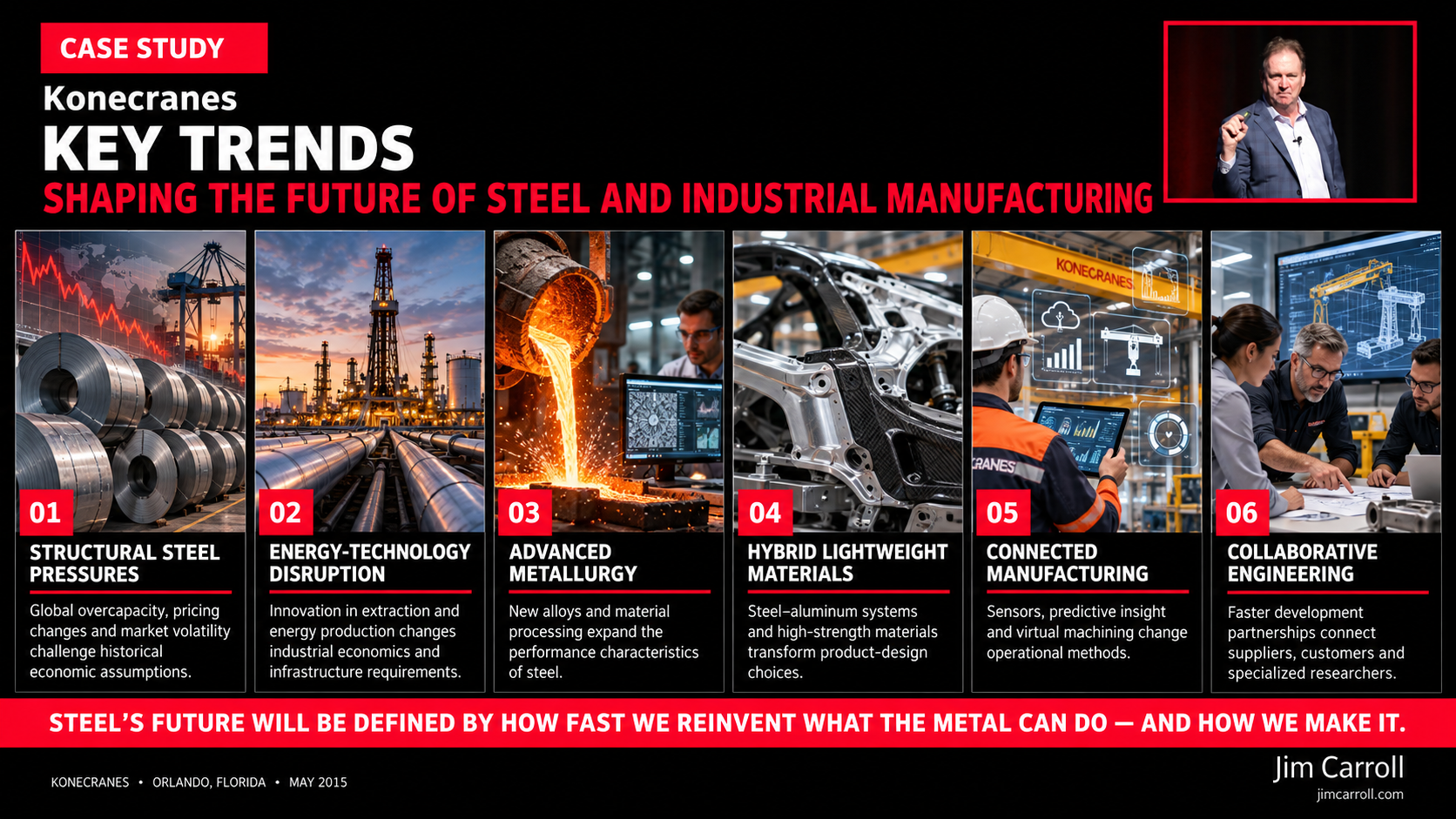
Six Trends Shaping Steel and Industrial Manufacturing:
- Structural Steel Pressures: Global overcapacity, pricing changes and market volatility challenge historical economic assumptions.
- Energy-Technology Disruption: Innovation in extraction and energy production changes industrial economics and infrastructure requirements.
- Advanced Metallurgy: New alloys and material processing expand the performance characteristics of steel.
- Hybrid Lightweight Materials: Steel–aluminum systems and high-strength materials transform product-design choices.
- Connected Manufacturing: Sensors, predictive insight and virtual machining change operational methods.
- Collaborative Engineering: Faster development partnerships connect suppliers, customers and specialized researchers.
STEEL'S FUTURE WILL BE DEFINED BY HOW FAST WE REINVENT WHAT THE METAL CAN DO — AND HOW WE MAKE IT.